
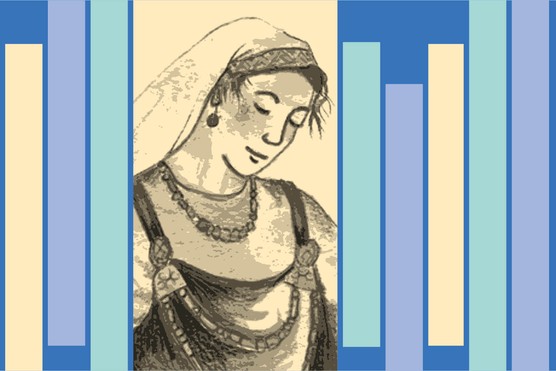
Gareth Evans describes Carol Clover’s article, Regardless of Sex,[1] as having “the greatest impact” on medieval Icelandic gender studies.[2] Clover argues for a “one-gender system,” whose standard was “something like masculine.” According to this model, the fundamental divide was not biological sex, but the ability to perform masculinity adequately (able-bodied men and exceptional women) versus a “rainbow coalition” of most women, children, slaves, and elderly men.[3]
Clover’s model falls short as a definitive framework, by treating the ‘feminine’ as the absence of ‘hvatr’,[4] it cannot explain the distinct forms of female agency evident in saga episodes of headdress, medieval burial practices, or the patronymic system. This essay, therefore, critiques Clover’s literary sources, introduces non-literary evidence, and proposes a flexible alternative.
Clover’s work must be understood in its historiographical context. When Clover published in 1993, gender scholarship increasingly examined what saga figures, such as Auðr the Deep-Minded (Auðr djúpúðga), revealed about medieval Icelandic society.[5] Clover’s move, arguing gender was an act of performance rather than a biological given, built on works such as Judith Butler’s influential Gender Trouble.[6] Yet, in challenging biological determinism, Clover has overcorrected and erased femininity as an independent category, a limitation of its European and Western theoretical moment.[7]
However, Clover’s model is useful in explaining medieval Icelandic society in four main ways. First, Clover suggests that if Norse society operated according to a single gender standard, and if the fundamental social divide was polarised between hvatr and blauðr, then women who demonstrated hvatr qualities were not “exceptions” to a binary gender system but successful performers on a singular gendered scale.[8] As Clover herself acknowledges, translating these terms poses significant problems that reveal deeper conceptual gaps between modern and medieval understandings of gender.[9]
Second, despite these translation issues, Clover points to selective examples to support her argument. Firstly, to Unnr (Auðr), who, after the death of her father and son, “had a ship built in secret and fled to … Iceland, where … she took possession of vast lands”[10] As Meulengracht Sørensen observes, “in every respect she has taken over the conduct and social functions of the male householder and leader”.[11] For Clover, Unnr is not a ‘masculine woman’ but a woman demonstrating hvatr qualities. However, we can alternatively argue that because the saga insists on recording her female sex, it suggests that biological sex remained fundamental to society, not just a starting point that evaporates upon performance.
Third, to further support her framework, Clover also points to the ‘ring-woman’ provision in Grágás, the Icelandic law code, as evidence that the one-gender model was institutionalised. The provision specifies that when a slain man has no male heir but does have an unmarried daughter, that daughter shall function as a male in matters of wergild.[12] This legal provision institutionalises what Clover calls “the female exception.”[13] Its existence suggests that medieval Icelandic law could contemplate a woman functioning as a juridical man. However, the fact that this required a specific legal provision demonstrates the rule that, normally, daughters could not function as sons. This exception proves the norm, not the absence of a binary.
Fourth, assuming, for the moment, we agree with Clover’s framework that female exceptionalism is a performance of hvatr, it also explains why male status can fall dramatically. Norse masculinity, in Clover’s analysis, is not fixed but precarious, constantly requiring maintenance and defence. The legal prohibition of nið insults testifies to this.[14] The logic of nið reveals a deeper structure: the man who penetrates is masculine; the man who is penetrated is feminine, regardless of his biological sex.[15] As such, a woman could become hvatr through exceptional behaviour, but a man could become blauðr through a single failure. To illustrate this volatility of masculine status, Clover employs Egil Skalla-Grímsson’s decline as an example.[16] Egil, the once most formidable warrior, is mocked by women in old age.[17] His lament Sonatorrek,[18] Clover suggests that it is a feminine (blauðr) lament, as age, infirmity, and the loss of homosocial support could push even the greatest hero down her gendered scale.
However, largely due to the nature of her primary source material, Clover’s model is not without its limitations. Clover builds her argument overwhelmingly on the Sagas of Icelanders (Íslendingasögur), treating these texts as transparent windows onto Medieval Icelandic society. This approach overlooks a fundamental problem. The sagas were written in Christian Iceland during the thirteenth and fourteenth centuries, depicting events that may have occurred two to three centuries earlier.[19] The gap between composition and setting has an ideological, religious, and literary impact littered with inconsistencies.
Focussing on Auðr and Njál, saga evidence also provides numerous passages in which these two characters, referenced by Clover, explicitly distinguish between men and women. In Laxdæla saga, Auðr is divorced because she had taken to “wearing breeches, with a codpiece, like a masculine woman”.[20] As Gareth Evans notes, the use of the word “woman” indicates that Auðr clearly retains her female status, while being gendered masculine.[21] The language itself encodes the distinction that Auðr is a woman performing masculine behaviours. Clover might argue that this supports her model, since Auðr successfully performs masculine traits while remaining biologically female. Nevertheless, the passage still depends upon the existence of recognisable male and female categories for the transgression to carry meaning.
Njál’s saga presents a deeper problem for Clover’s framework. Flosi uses the fact that Njál cannot grow a beard to question his sex,[22] using this biological deficiency to question his masculinity. As Oren Falk argues, “for the Norse, the notional presence of facial hair unequivocally indexed manliness”.[23] In this case, masculinity is tied to biological features of male sex that cannot be socially performed or acquired. If Clover’s model were accurate, if biological sex were of little consequence, Njál’s inability to grow a beard should not carry such an impact. Instead, the saga treats deficient masculinity as rooted partly in the male body itself.
This highlights the fundamental theoretical problem with Clover’s one-gender model, which lies in its conceptualisation of how gender functions as a social category. In other words, masculinity and femininity are related concepts, “which have meaning in relation to each other, as a social demarcation and a cultural opposition”.[24] If there is only one gender standard, it becomes impossible to explain how that standard acquired meaning. A purely one-dimensional system collapses into a simple hierarchy without the dynamics that gender opposition produces. Even if we accept hvatr/blauðr as a continuum, a polar conception of gender remains the organising principle. Clover’s framework does not eliminate the binary.[25]
Returning to the logic of níð insults reinforces this point. Clover argues that because the worst insult accuses a man of being penetrated, society operated on a single gendered scale.[26] However, this inverts the logic of prohibition; the severity of the níð insult assumes a strict binary that must not be crossed. If Iceland truly had a ‘one-gender system,’ being called ragr, rendering one blauðr could be a temporary demotion, not a life-ending disgrace.
A crucial oversight is that blauðr may primarily function as an insult rather than a genuine gender category. Clover builds a one-gender model based largely on the pattern of insults, then uses that continuum to explain why the insults are so devastating. However, we might equally conclude society was invested in a binary, because violating its norms was so shameful. As Folke Ström observed, “injurious remarks… tell us something about the existing set of social values.”[27] The penalty of full outlawry tells us, [28] the boundary between hvatr and blauðr was treated as absolute, which is the very definition of a binary, albeit one with performance-based permeability.
David Clark, like Clover, also notes that “the worst insult one man can level at another in the Icelandic laws is to call him sannsorðinn or ragr. That is, to state that he has been penetrated.”[29] But Clark argues that the active role in same-sex activity was not stigmatised in pre-Conversion Iceland,[30] while the passive role was precisely because it was associated with femininity. This requires the existence of a meaningful category of femininity to which it can be associated.
If Clover’s model struggles to explain deficient masculinity, it also struggles to explain feminine forms of agency rather than masculine. Saga literature presents women exercising power through distinctly female symbols and behaviours, alongside occasions of successful masculine performance. In Eyrbyggja saga, Asdis’s high headdress functions as a marker of status that, despite their obvious masculinity, berserks Hallr and Leikner cannot overcome.
As Judy Quinn notes, Asdis’s “inscrutability” signifies a social position inaccessible to them. [31] In Orkneyinga saga, Ragna similarly uses feminine symbolism to exercise authority when she wears a red headdress made from a stallion’s tail, rather than a mare’s, to meet Earl Rognvaldr. By subverting gender expectations, she forces Earl Rognvaldr to acknowledge that “no man knows all” and accept her counsel.[32] These episodes depict a specifically feminine form of agency that operates, in this case, through dress. As such, these are instances that men cannot replicate, showing that the feminine embodies its own cultural authority. This stands in contrast to Clover’s one-gender model, because it suggests that femininity was not simply the absence of hvatr, but was instead an active category through which women could exert agency and influence.
The issues with Clover’s framework are not confined to saga literature alone. Non-literary evidence from archaeology and kinship studies also challenges Clover’s view that medieval Iceland operated under a one-gender framework. For example, Clover supposes that the lack of archaeological evidence for female burials suggests high levels of female infanticide. In contrast, Orri Vésteinsson notes that while pagan cemeteries show sex imbalance, the total number of graves is too few to account for even the adult males likely to have died on that farm. He estimates that up to “two-thirds of the population are missing… including some adult males”.[33]
Vésteinsson suggests that the key distinction in pagan burial practice was not sex but “personhood”. Personhood is the control of resources rather than sex.[34] In his view, formal burial was accorded to those who had acquired enough personhood to represent the household in the other world. This framework, then, stands in opposition to Clover’s view that female children were systematically killed or that women were largely devalued. Moreover, the transition to Christian burial saw the emergence of sex-balanced cemeteries, further suggesting that the pagan burial record reflects status and personhood rather than a one-gender ideology.[35]
Vésteinsson’s understanding of ‘personhood’ does not directly disprove Clover’s one-gender model, since burial practices reflect beliefs about death rather than a daily social hierarchy. Nevertheless, it undermines her argument that a grave imbalance proves female infanticide. If two-thirds of all people, including adult males, are missing from pagan cemeteries, cemetery data cannot bear the weight Clover places on it. At the very least, this suggests a more complex status system in which sex was one factor among several.
Von Mallinckrodt’s feminist critique directly challenges Clover’s reliance on burial imbalance as evidence of female infanticide, showing how excavation bias and modern stereotypes influence interpretation. She shows that sites with balanced or female-skewed sex ratios are more common than traditionally acknowledged, casting doubt on Clover’s argument that an apparent lack of female burials reflects deliberate neglect of female infants.[36]
If Von Mallinckrodt indicates what extreme male dominance was not, Katherine Marie Olley shows what structural male dominance was. Olley demonstrates that the patronymic naming system was a fundamental organising principle of Old Norse society.[37] Paternal descent structured identity, inheritance and social obligation from birth. If Clover’s model were seamless, we might expect patronyms and matronyms to be used depending on achievement; instead, the stability of the patronymic naming system indicates a society that took biological paternity seriously, reinforcing a male/female binary by grounding individual identity in a gendered relation to a father.
This leads us to consider alternative frameworks, such as ‘Hegemonic masculinity’, as Evans outlines, “hegemonic masculinity… the configuration of gender practice that embodies the currently accepted answer to the problem of the legitimacy of patriarchy, which guarantees the dominant position of men and the subordination of women”.[38] Thus, restoring the binary and explaining how masculinities are produced in relation to femininity. However, this model also risks reducing femininity to a sub-category in a masculine framework. The evidence from saga literature, burial practices, and kinship shows that femininity was not subordinate to patriarchy, but also a source of agency in its own right.
This essay’s argument, therefore, is that medieval Icelandic society is best understood through a recognition of both the masculine and the feminine. Masculinity, in medieval Iceland, was of a precarious nature and required constant negotiation, while femininity was also an active, and recognisable force. Rather than readily adopting Clover’s model or other frameworks, we should see Icelandic gender as an interaction of masculine and feminine categories, each shaping the other. This view, then, not only challenges the idea of Clover’s ‘one-gender model’ but also moves beyond ‘hegemonic masculinity’, toward a model that acknowledges the independent presence of femininity in the saga world and its role in structuring social power.
In conclusion, rather than being a conclusive framework, Clover’s model allows scholars of medieval Iceland to take the performative nature of gender seriously. However, as an all-encompassing theory, it goes too far, erases distinctions the sagas maintain, and rests on selective sources. The patronymic system, saga evidence for sex distinction, and archaeological personhood all indicate that biological sex mattered in ways that Clover does not consider.
The questions that Clover’s model pushes us as scholars to ask are: when did sex matter, and when did performance of gender override the importance of sex? Answering these questions requires expanding on Clover’s initial framework to a more flexible model of gender that preserves Clover’s understanding of masculinity’s precarity, while restoring biological sex, kinship structures, and the obvious presence of the feminine in the saga world.
Finally, this essay has argued that while Evans’s model of hegemonic masculinity is more flexible than Clover’s one-gender system, it still risks diminishing femininity to a subordinate role within a masculine hierarchy. Future approaches should instead insist on recognising femininity as an active category of socio-cultural agency in its own right. This dual recognition allows for greater nuance, allowing academics to consider how class, slavery, age, and other social positions intersect with sex to produce a spectrum of identities beyond Clover’s “rainbow coalition.” In this way, gender analysis can reflect the full complexity of medieval Icelandic society.
[1] Carol J Clover, ‘Regardless of Sex: Men, Women and Power in Early Northern Europe’, Speculum 68, 2 (1993): 363-367.
[2] Gareth Lloyd Evans, Men and Masculinities in the Sagas of Icelanders, (Oxford: Oxford University Press, 2019), 11.
[3] Clover, ‘Regardless of Sex’, 379-386.
[4] This essay’s understanding of hvatr includes ‘bold and vigorous’ and is typically applied to men who demonstrate prowess. Blauðr, hvatr’s antonym, connotes cowardice, effeminacy, and extreme sexual passivity (ragr). Hvatr and blauðr are not direct equivalents of modern ‘masculine’ and ‘feminine’. Rather, they are culturally specific terms that overlap with those categories in certain contexts. See Clover, ‘Regardless of Sex’, 363-364; Meulengracht Sørensen, The Unmanly Man. Concepts of Sexual Defamation in Early Northern Society, (Odense: Odense University Press, 1983), 15-22; and Evans, Men and Masculinities.
[5] Keneva Kunz (Trans), The Saga of the People of Laxardal and Bolli Bollasson’s Tale, (London: Penguin Classics, 2008); See for an introduction on the emergence of gender matters, Jóhanna Katrín Friðriksdóttir, ‘Gender’, in The Routledge Research Companion to the Medieval Icelandic Sagas, ed. Ármann Jakobsson and Sverrir Jakobsson (Oxon: Routledge, 2017), 409.
[6] Judith Butler, Gender Trouble, (New York: Routledge, 1990); See also, Judith Jesch, Women in the Viking Age (The Boydell Press: Woodbridge, 1991).
[7] Friðriksdóttir, ‘Gender’, 409.
[8] Clover, ‘Regardless of Sex’, 363-364, employs an example from Gísla saga in which the bounty hunter Eyjólfr, after being struck in the nose by Auðr with a purse of silver, orders his men: “Seize the dog and kill it, though it be blauðr.”
[9] Ibid. 363-364.
[10] Ibid. 366.
[11] Sørensen, The Unmanly Man, 22, quoted in ‘Regardless of Sex’, 366.
[12] A. Dennis, P. Foote, and R. Perkins, The Laws of Early Iceland: Grágás, Vol. II. (Winnipeg: University of Manitoba Press, 2000), 2–4.
[13] Clover, ‘Regardless of Sex’, 368.
[14] Ibid, 375; The term Nið encompasses a range of verbal insults that infer unmanliness, cowardice, or sexual passivity. The most severe form, ragr, accuses a man of being the passive partner in same-sex activities. Under Grágás, uttering such accusations carried the penalty of full outlawry, reflecting the distinct social danger of such claims. See, The Laws of Early Iceland, 197.
[15] Ibid. 375.
[16] Ibid. 382.
[17] Hermann Pálsson and Paul Edwards (Trans), Egil’s Saga, (London: Penguin Classics, 1976), 235–237.
[18] Sonatorrek translates to “Loss of my Sons.”
[19] For example, see Adolf Fridriksson and Orri Vésteinsson, ‘Creating a Past: A Historiography of the
Settlement of Iceland’, in Contact, Continuity, and Collapse: The Norse Colonisation of the North Atlantic, ed. James H. Barrett, (Turnhout: Brepols, 2003), 139-61.
[20] Kunz (Trans), The Saga of the People of Laxardal and Bolli Bollasson’s Tale, 53.
[21] Evans, Men and Masculinities in the Sagas of Icelanders, 12.
[22] Robert Cook (Trans), Njal’s Saga, (London: Penguin Classics, 2001), 229.
[23] Oren Falk, ‘Beardless Wonders: The Sex was Great’, in Verbal Encounters: Anglo-Saxon and Old Norse Studies for Roberta Frank, ed. Antonina Harbus and Russell Poole (Toronto: University of Toronto Press, 2005), 235.
[24] Evans, Men and Masculinities in the Sagas of Icelanders, 40.
[25] Ibid. 15.
[26] Clover, ‘Regardless of Sex’, 374-376.
[27] Folke Ström, Níð, Ergi and Old Norse Moral Attitudes (London: University College London, 1974), 15.
[28] Dennis, Foote, Perkins, The Laws of Early Iceland, 552.
[29] David Clark, Gender, Violence, and the Past in Edda and Saga, 52.
[30] Ibid. 108.
[31] Judy Quinn, ‘Women in Old Norse Poetry and Sagas’ in A Companion to Old-Norse-Icelandic Literature and Culture, Second Edition. Ed. Rory McTurk (Oxford: Blackwell Publishing, 2004), 521.
[32] Hermann Pálsson and Paul Edwards (Trans). Orkneyinga Saga: The History of the Earls of Orkney, (London: Penguin Classics, 191), 133–134.
[33] Orri Vésteinsson, ‘Conversion and Cultural Change: Burial Paradigms in Viking Age Iceland’ in The Introduction of Christianity into the Early Medieval Insular World: Converting the Isles I, ed. by Roy Flechner and Máire Ní Mhaonaigh, (Turnhout: Brepols, 2016), 335.
[34] Ibid. 336.
[35] Ibid. 334.
[36] Maren Clara von Mallinckrodt, ‘Selective Female Infanticide in the Viking Age: A Feminist Critique’, Journal of Social Archaeology 26, no. 1 (2025): 70-89.
[37] Katherine Marie Olley, Kinship in Old Norse Myth and Legend (Woodbridge: Boydell, 2022), 30.
[38] Evans, Men and Masculinities in the Sagas of Icelanders 16.; See also, R. W. Connell, Masculinities (London: Routledge, 2005).
 Bill’s History Blog
Leave a comment