
It has been just under a year since I last wrote on my blog about ‘authenticity’ in multicultural Britain (Part 1). My understanding of ‘authenticity’ has been a developing process that I have contended with for around 18 months. This has been both through my previous academic work (which I have recently revisited) and my progressing MA dissertation.
Within the MA dissertation writing process, I have gratefully received useful feedback regarding the use of loaded terminology. When using words such as ‘authenticity’, I was encouraged to be more definitive about what I meant.
This longer period of thought, pushed by constructive feedback, led to a 2am breakthrough. I quickly sprang out of bed to make notes, albeit still jet-lagged. This blog post is the culmination of that process and a desire to share my understanding in more detail than perhaps one or two sentences within my dissertation will allow.
Rather than a fixed understanding of authenticity, I will here suggest a framework for understanding why authenticity in diasporic food is scalable. What feels authentic at home, what is presented as authentic by diasporic communities, and what is recognised as authentic in British society may be connected, but they are not identical. Each zone of authenticity has a bidirectional impact on the others, while being influenced by external factors such as migration, memory, globalisation and changing relationships with places of origin.
For the moment, I am focusing my energy mainly on diasporic food. While these ideas may be extended to a wider diasporic context of cultural expression and identity— perhaps to be developed in a later episode in this series — I require further time to develop my thoughts and academic understanding. Nevertheless, food provides a useful stepping stone into the subject as it is both personal and public. It is produced at home, sold in restaurants and takeaways, adapted for the supermarket and is consumed every day.
The academic debate on authenticity has long been focused on whether authenticity is inherent or constructed. Erik Cohen (1988) argued that authenticity is not an inherent quality but a negotiated and socially constructed concept; in short, authenticity is not fixed and can therefore be scaled through differing social contexts.
More recently, on the topic of food, Merin Oleschuk’s Foodies of Colour (2016) demonstrates how frames of authenticity and exoticism can encourage cross-cultural understanding on one hand but also can maintain racial inequalities on the other, allowing predominantly white consumers to accumulate cultural capital while essentialising non-white culinary traditions.
However, my interpretation differs. Influenced by my past and ongoing research, it places greater emphasis on change over time within multicultural Britain. In Britain, diasporic food is not only shaped by the expectations of the host society. The host society itself gradually becomes more acquainted with diasporic foods as the diaspora itself expands and diversifies. Over time, this shifts the terms of who gets to claim and define authenticity.
This is not to erase histories of discrimination or ongoing inequality. Instead, it is to recognise that the answer to who decides authenticity varies by context. The framework centralises and acknowledges the importance of the historic complexities of the bidirectional integration process where diasporic communities are not only changed by British society, internal diversity, external influences and changing relationships with their places of origin. They have also changed British society (see Lucassen, for example). Therefore, my prior understanding (set out in my previous blog post) has not changed wholesale, and I continue to assert a somewhat loose definition of authenticity in multicultural Britain.
My previous post on this topic used the example of the Balti, a dish that emerged in Birmingham, produced by South Asian migrants. The dish is presented and consumed as ‘Indian’ food in Britain, despite its history of migration, adaptation and localised British ‘invention’. In this context, I questioned: knowing the history of the dish, should we define it as Indian, British Indian, or British?
My answer was that it does not really matter. At the time, my reasoning was that authenticity remains fluid, vague and flexible, and migrants over time integrate into new societies, introducing ingredients, cooking techniques and flavours. At the same time, the host society also adapts, embracing both new flavours and innovations. I still present this as my view, but I am now able to provide further explanation.
To demonstrate this, I have created a diagram of what is undoubtedly an oversimplification of the actual process:
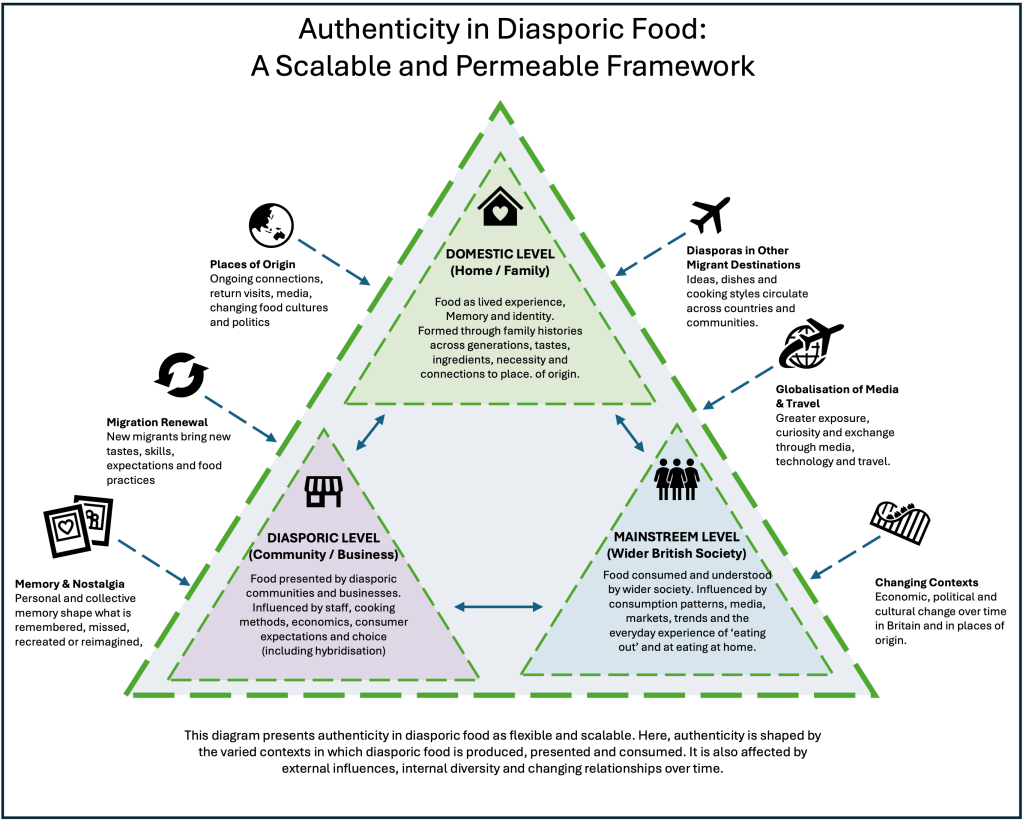
The diagram presents, within a larger triangle, authenticity in a diasporic and host-society context. It contains three smaller permeable triangles within one larger permeable triangle. These smaller triangles represent the scales of authenticity, which I have called: the Domestic Level, the Diasporic Level and the Mainstream Level.
The triangles are positioned in this way for a couple of reasons. First, rather than a pyramid-style hierarchy, I did not wish to infer a scale from the inauthentic to authentic. The point is not that authenticity becomes ‘real’ as it moves from the home to the restaurant or to the wider society, or vice versa. Instead, the scale focuses on the context in which the food is produced, presented, consumed and understood.
Second, each singular small triangle has a bidirectional relationship with the others. Food eaten at home can influence what is presented by diasporic restaurants or takeaways. Food presented by these takeaways can influence society’s expectations. Wider society can then shape what diasporic businesses offer, and even affect what younger migrant generations come to associate with their own identities. This scale does not attempt to suggest that these relationships are linear or equal in power, but suggests that they are interconnected.
The larger triangle is also permeable. It is influenced by external factors outside the host society, such as diasporas in other migrant destinations, continuing migration of people and ideas, and, notably, changing places of origin. The true picture is more nuanced and complex than any framework can present. However, I hope this framework provokes the reader to think about authenticity as more than just a single quality, but as nuanced and produced across contexts.
Domestic Level
At the Domestic Level, authenticity can be deeply personal. There is often a high level of heterogeneity and complexity from one person or family to the next. Diasporic families come from varied places of origin, with different regional, linguistic, cultural, religious and political backgrounds. For example, the places of origin for the Chinese in Britain include Hong Kong, Taiwan, Macao, Vietnam, Singapore, Malaysia and mainland China, among others (Benton & Gomez 2008). To speak of “Chinese food” in Britain is to make a simplification of a complex collation of histories and identities.
Generational change also matters. First-generation migrants may have specific relationships with foods from their place of origin, formed through memory, ingredient availability, adaptation and a feeling of belonging. Second or further generations may experience authenticity differently. Authenticity could be, for them, an experience of reclamation, reinterpretation or recovery of foods associated with family, nostalgia or identity. (see, Ma 2024. Hui 2022, for example) In this way, authenticity can be more about connection than replication.
There are other complicating factors, too. Families may have settled in another country before moving again to Britain. There may be a level of inter-marriage, which is higher in some migrant communities than others, (Panayi 2010) or they may be influenced by class, religion or even by their route of migration. Available ingredients and ingredient costs in Britain may also differ from those available elsewhere. Family recipes may be adapted through necessity or newly formed habits. Yet, all of this complexity does not make food in the diaspora inauthentic but instead authentic to individual histories and tastes.
Diasporic level
At the diasporic level, authenticity becomes more public. Here, food is not only eaten in the home; it is presented to others in a communal context. The various forums where one can ‘eat out’, such as the restaurant or takeaway, all help to shape what is widely recognised as diasporic food.
Such presentation is affected by factors such as staff, ingredients, cooking methods, consumer expectations, economic constraints and deliberate decisions to create hybrid dishes. A dish may change in order to suit its wider market, but not so much that it loses its assigned national identity (see Panayi 2008, for discussion on the nationality of food).
The diasporic level is also impacted by different types of consumers. Returning to the example of Chinese food in Britain, many British consumers are largely familiar with an anglicised version of Chinese food. For some, this beloved version may be what ‘Chinese food’ means. At the same time, Britain’s Chinese food landscape has changed. The changing British palate, international students, newer migrants and an increasingly global appreciation have created the demand and opportunity for diasporic communities to produce dishes and flavours that may previously have been less visible in Britain. (see Ma 2024, for example) Authenticity at the diasporic level is then not simply a preservation of the domestic understanding but is a negotiation between preserving the essence of ‘Chinese food’ and competing market, community and consumer demands, alongside a willingness to recognise the changing mainstream and adapt.
Mainstream level
At the mainstream level, wider British habits of consumption shape understandings of diasporic food. These patterns of consumption impact both what diasporic communities present and how they present it. Large differences can occur between the food eaten in the familial home and the food consumed by wider British society in a restaurant or takeaway. (Hui 2022) This again is an example of authenticity being produced in differing contexts.
The mainstream consumer may eat diasporic food on a weekly, fortnightly, or monthly basis, perhaps as a treat or as part of a routine. This affects how such dishes are understood. A takeaway, for example, may be associated with indulgence, convenience and comfort. Market preferences also influence flavour, where ingredients such as the Sichuan pepper may be replaced with increasing amounts of sugar and salt to meet local expectations.
Over time, diasporic foods can become embedded within British society. Dishes such as the Balti, the Bao bun or Kung Pao Chicken are subject to innovative adaptations, increasingly experimental flavours and combinations. They appear in supermarkets and food festivals and become increasingly part of Britain’s wider food culture.
It is also important to note that British society is not a monolith. It may have mainstream consumer patterns, but it is not culturally homogenous. This is especially true in cities such as London, Leicester and Birmingham, which have long histories of migration. In these localised settings, the permeable boundaries between diasporic food cultures and mainstream cultures can be seen more clearly.
External and transnational influences
The three levels described above are also influenced by factors outside Britain. Diasporic communities maintain connections with places of origin through memory, family, travel, media and continued migration. These connections can renew or change understandings of authenticity. A dish that has become established in Britain by earlier migrants may later be re-evaluated when newer migrants arrive with different expectations of what the dish should be.
This is explained by the fact that places of origin also change over time. For example, two migrants leaving the same place twenty years apart are not leaving the same cultural context. Food cultures in places of origin are themselves shaped by urbanisation, globalisation, class, politics, migration and changing consumer habits. Stuart Hall’s work on cultural identity (1990) is useful here because it reminds us that identity is not simply a matter of recovering a fixed past. Instead, identity is also produced through change, memory and representation.
Secondary migration is another factor. Secondary migrants can bring foods and ideas from another host society. A dish may therefore arrive in Britain not directly from migrants’ places of origin, but through another diasporic context, adding another layer of complexity.
The complexity becomes almost ineffable when applying a version of the same framework to migrants’ places of origin. There, food is also negotiated between homes, restaurants and national identity. Ingredients that were once unavailable can become naturalised over time. This is why a true, singular level of ‘authenticity’ cannot be defined; rather, it exists in many forms.
In Britain, diasporic communities, through food, have left an indelible mark on high streets, diets and everyday culture. We are the better for it. These foods are not merely additions to British society; they are part of what British society has become. This process is continuous. It is why the question of authenticity matters, and understanding the context in which authenticity is claimed is important.
If this framework can be extended from food to wider cultural expressions of identity, it would go some way to contributing to bidirectional understandings of integration. As migrants integrate into host societies, host societies also adapt, albeit less and often imperceptibly.
Certainly, over time, the signs of this process are visible, and our food, our taste buds, and our society are richer for it.
 Bill’s History Blog
Leave a comment